
Email marketing can be one of the most effective ways to stay connected with customers, but simply sending emails does not guarantee results. Many small businesses build a list, send an occasional promotion, and then wonder why subscribers are not opening, clicking, or buying.
The problem is rarely email itself. More often, businesses send the wrong message, to the wrong people, at the wrong time, or without giving subscribers a clear reason to pay attention. Following proven email marketing best practices helps turn email from another marketing task into a channel that builds relationships and supports sales.
This guide explains how to improve each stage of your email marketing, from building a quality list and writing subject lines to increasing clicks, protecting deliverability, and measuring the metrics that actually matter.
Why Email Marketing Best Practices Matter
Good email marketing is not about sending as many messages as possible. It is about consistently delivering something useful enough that subscribers want to keep hearing from your business. When your emails are relevant, easy to understand, and sent to people who actually asked for them, engagement tends to improve while unsubscribes and spam complaints become less of a concern.
Email Gives You a Direct Connection With Your Audience
Social media and search engines can introduce people to your business, but you do not control those platforms. Algorithms change, advertising costs fluctuate, and your organic reach can rise or fall without warning.
An email list gives your business a more direct way to communicate with people who have already shown interest in what you offer. That makes it especially valuable for nurturing potential customers who may not be ready to purchase during their first interaction with your business.
Better Engagement Can Support Better Business Results
Opens and clicks are useful indicators, but they are not the final goal. An effective email program should eventually contribute to actions that matter to your business, such as purchases, appointments, quote requests, repeat orders, or referrals.
That is why email marketing should be measured as part of the customer journey rather than as a competition for the highest possible open rate.
Build an Email List People Actually Want to Join
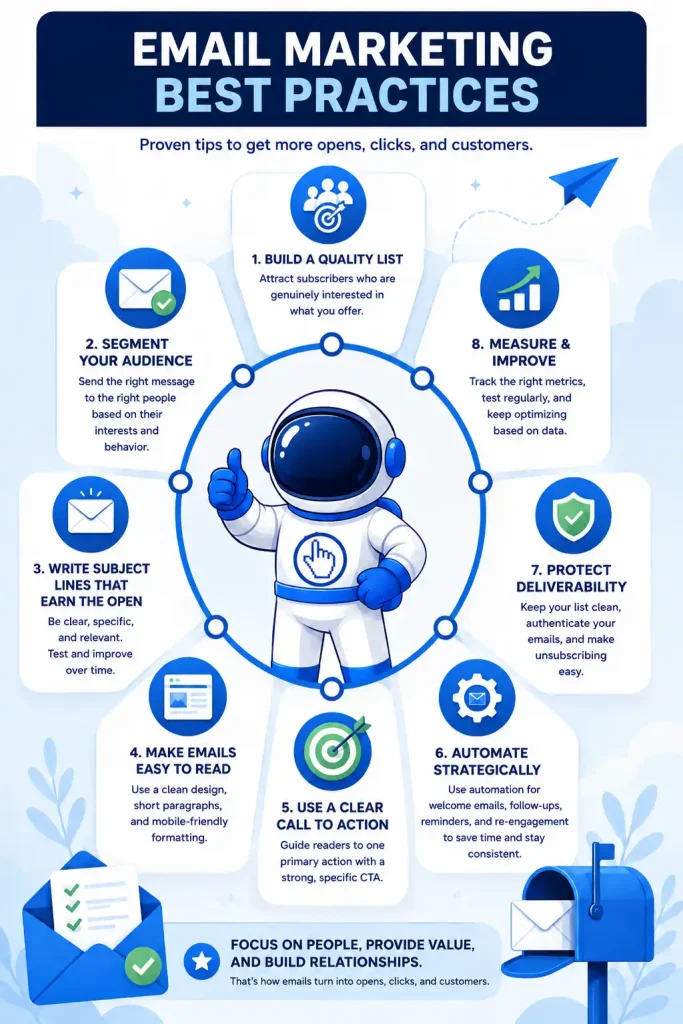
A large email list may look impressive, but list size means very little when most subscribers have no interest in your business. A smaller list of people who intentionally signed up can often be far more useful than thousands of poorly targeted contacts. One of the most important email marketing best practices is therefore to focus on list quality before worrying about list quantity.
Give People a Clear Reason to Subscribe
“Join our newsletter” is not always a strong enough reason for someone to hand over their email address.
Instead, explain what they will receive.
For example, an accounting firm could offer a small business tax checklist. A landscaping company could offer seasonal lawn care tips. A B2B software company might provide a useful template or industry guide.
The incentive does not have to be complicated. It simply needs to solve a problem your ideal customer already cares about.
Never Buy an Email List
Buying email addresses may seem like a shortcut to reaching more people, but those recipients did not ask to hear from your business. That can lead to poor engagement, spam complaints, and damage to your sender reputation.
Build your list through legitimate opt-ins instead. Website forms, lead magnets, purchases, events, consultations, and other direct interactions can all help you attract subscribers who actually recognize your business.
Segment Your Email List
Sending every email to every subscriber is one of the easiest ways to make your marketing feel irrelevant. Segmentation means dividing your email list into smaller groups based on characteristics or behavior so you can send more appropriate messages. In HubSpot’s recent email marketing research, 90% of email marketers surveyed said segmentation improves performance, reinforcing how important relevance has become.
Start With Simple Segments
Segmentation does not need to become an enormous technical project.
A small business might start with groups such as:
- Prospects who have never purchased
- First-time customers
- Repeat customers
- Customers interested in a particular service
- Subscribers who have recently clicked an email
- Subscribers who have not engaged for several months
These groups allow you to communicate based on what you already know about each subscriber.
For example, someone who requested information about commercial landscaping should probably receive different follow-up emails from someone who downloaded a guide about residential lawn maintenance.
Match the Message to the Subscriber
Segmentation works because relevance matters.
Someone considering their first purchase may need education and reassurance. An existing customer may respond better to complementary products, maintenance reminders, upgrades, or loyalty offers.
The question should not simply be, “What email should we send this week?” A better question is, “What would this particular group of customers find useful right now?”
Write Subject Lines That Earn the Open
Your subject line has one job: give the recipient a reason to consider opening the email. Clever wording can sometimes work, but clarity and relevance are usually more important than trying to make every subject line sound dramatic. Subject lines should accurately reflect the content of the email rather than relying on misleading curiosity or exaggerated promises.
Be Specific About the Value
Compare these two subject lines:
“Big News From Our Team!”
“5 Ways to Reduce Your Office Energy Costs”
The second gives the reader a much clearer idea of what they will gain by opening the email.
Specific subject lines work because they reduce uncertainty. The subscriber can quickly decide whether the message is relevant to them.
Avoid Fake Urgency
Phrases such as “ACT NOW!!!” or “LAST CHANCE!!!” can quickly become tiresome when every email is positioned as an emergency.
Urgency is useful when it is real. If registration actually closes Friday or a promotion genuinely ends tonight, say so. Otherwise, focus on the value of the message.
Test Instead of Guessing
There is no universal perfect subject line. What works for an online retailer may not work for an accounting firm, contractor, dentist, or B2B consultant. A/B testing lets you compare variations with your own audience instead of relying entirely on generic advice.
You might test curiosity against specificity, shorter versus longer subject lines, questions versus statements, or personalized versus non-personalized versions.
Make the Email Easy to Read
Getting someone to open an email is only the first step. If they immediately see a large wall of text, confusing design, or five competing offers, they may leave without taking action. Effective marketing emails should make it easy for readers to understand what matters, even when they are quickly scanning on a phone.
Lead With the Most Important Message
Do not make subscribers work to figure out why you emailed them. The opening should quickly establish what the email is about and why it matters.
If you are announcing a new service, say so. If you are teaching the reader something useful, introduce the problem. If you are offering a promotion, explain the offer clearly.
Keep the Design Simple
Complex email designs are not automatically more persuasive. Use short paragraphs, clear headings when needed, adequate spacing, readable fonts, and buttons that are easy to tap. Images should support the message rather than overwhelm it.
Accessibility matters too. Litmus reported that only 47% of companies in its 2025 research incorporated even basic accessibility practices such as alternative text for images. Adding alt text, maintaining good color contrast, and using meaningful link text can make your emails easier for more people to use.
Give Every Email a Clear Call to Action
Many emails lose clicks because they ask readers to do too many things at once. A subscriber sees links to a blog post, three services, five social networks, a consultation page, a sale, and the company homepage, then does nothing because there is no obvious priority. Strong email marketing usually makes the next step easy to identify.
Focus on One Primary Action
Before writing an email, decide what you most want the reader to do.
That action might be:
- Read an article
- Schedule an appointment
- Request a quote
- Buy a product
- Register for an event
- Download a resource
- Reply to the email
Other links can sometimes appear, but your primary call to action should stand out.
Make Your CTA Specific
Generic buttons such as “Learn More” can work, but specific language often gives readers more context.
For example:
“Download the Checklist”
“View Available Appointments”
“See the Pricing Options”
“Read the Full Guide”
Clear calls to action tell subscribers exactly what will happen when they click.
Personalize Beyond the First Name
Personalization is frequently reduced to placing someone’s first name in the subject line, but meaningful personalization goes much further. The most useful emails reflect what the subscriber has purchased, viewed, requested, downloaded, or shown interest in. HubSpot reports that more than 80% of marketers saw some performance improvement when using tactics including subject line personalization, real-time content, and dynamic content personalization.
Use the Information Customers Give You
Imagine two customers visiting an HVAC company’s website. One downloads a guide about replacing an aging air conditioner. Another signs up for reminders about seasonal maintenance.
Sending both people an identical series of promotional emails ignores what each person has already told the company. Instead, their behavior can guide the next conversation.
Useful personalization feels helpful because it makes the content more relevant. Unnecessary personalization can feel intrusive, so use customer data to improve the experience rather than simply proving how much data you have collected.
Use Email Automation Strategically
Email automation allows you to send messages based on timing or subscriber behavior instead of manually creating every interaction. For a small business, automation can be particularly valuable because it creates consistent follow-up without requiring someone to remember every customer touchpoint. The goal is not to automate every conversation, but to automate predictable moments where a useful message can help move the relationship forward.
Start With a Welcome Sequence
A welcome sequence is one of the easiest automations to build. When someone subscribes, you could send a short series introducing your business, delivering the promised resource, answering common questions, and pointing them toward another useful next step.
That is usually more effective than adding a new subscriber to your database and waiting several weeks before they hear from you again.
Look for Repetitive Customer Moments
Good automation opportunities often already exist in your business.
Consider emails for:
- New subscriber welcomes
- Appointment reminders
- Abandoned purchases
- Post-purchase follow-ups
- Review requests
- Educational sequences
- Renewal reminders
- Re-engagement campaigns
Automation should make communication more timely, not more robotic.
Protect Your Email Deliverability
The best email in the world cannot generate results if it never reaches the inbox. Email deliverability is influenced by factors including sender reputation, authentication, list quality, subscriber engagement, and sending behavior. Litmus identifies sender reputation, authentication infrastructure, sending cadence, list quality, and engagement among the factors that can affect whether marketing emails reach recipients successfully.
Keep Your List Clean
Subscribers naturally become inactive over time. Someone may change jobs, abandon an old email address, lose interest, or simply stop engaging with your business. Continuing to send indefinitely to large numbers of inactive contacts can reduce the overall quality of your list.
Consider creating a re-engagement campaign for inactive subscribers. If they remain unresponsive, removing or suppressing those contacts can help you focus on people who still want your messages.
Make Unsubscribing Easy
Trying to hide the unsubscribe link does not create loyal subscribers. People who no longer want your emails should have a simple way to leave. Making that process difficult can frustrate recipients and increase the chance that they mark your messages as spam instead.
A healthy email list is not one where nobody unsubscribes. It is one where the remaining subscribers genuinely want to hear from you.
Find the Right Email Frequency
There is no universal rule that every business should send once a day, once a week, or once a month. The right frequency depends on why people subscribed, how quickly your business changes, what you have to say, and what your audience considers useful. Consistency usually matters more than choosing an arbitrary number of emails.
Set Expectations Early
If possible, tell subscribers what they are signing up for. You might promise weekly marketing tips, monthly company updates, occasional promotions, or notifications when new inventory becomes available.
When your sending pattern matches what subscribers expected, your emails are less likely to feel intrusive.
Watch Engagement for Warning Signs
If opens, clicks, or conversions consistently decline while unsubscribes increase, frequency could be one factor worth testing.
Mailchimp recommends comparing open and click performance with relevant benchmarks and considering sending frequency when engagement is significantly below expectations.
Do not automatically assume that sending fewer emails is the answer, though. Poor targeting or uninteresting content can create the same symptoms.
Measure More Than Open Rates
Open rates can help you understand whether people are noticing your emails, but they should not be treated as the ultimate measure of success. Click rates, conversions, unsubscribes, revenue, replies, and other business outcomes can provide much more context. Mailchimp identifies metrics including open rate, click-through rate, unsubscribe rate, and ROI as useful parts of email reporting.
Track the Metrics That Match Your Goal
If the purpose of an email is to generate consultation requests, consultation bookings matter more than opens.
If you sent customers to an educational guide, clicks and engagement on that page may be more meaningful.
If you operate an ecommerce store, revenue per campaign could matter more than either metric.
According to HubSpot’s 2026 marketing statistics page, average email click-through rates across industries were about 2.5% based on its 2025 data. Benchmarks can provide context, but your own historical performance is often the more useful comparison.
Look for Trends Over Time
One email does not tell you whether your strategy is working. Track results across several campaigns. Look for patterns by topic, audience segment, offer, sending time, subject line, and call to action.
Over time, your own data can tell you much more about your customers than a generic list of email marketing benchmarks.
Test One Thing at a Time
Small businesses sometimes change the subject line, email design, offer, call to action, and sending time all at once, then have no idea which change affected the results. Testing works best when you isolate variables so you can learn from each experiment. Email marketing optimization should be a continuous process rather than an attempt to discover a single perfect formula.
Build a Simple Testing Routine
Choose one variable.
For example, test two subject lines while keeping the email itself the same. Next time, test two calls to action. Later, compare a shorter email with a longer educational version.
Keep notes about what you tested and what happened.
Over several months, those small experiments can create a practical playbook based on your actual audience rather than someone else’s assumptions.
Treat Email Like a Relationship, Not a Broadcast
The most important email marketing best practice is also one of the simplest: remember that there is a person on the other side of the inbox. Subscribers do not exist to improve your open rate, and they rarely want a constant stream of promotions. Businesses that use email to answer questions, solve problems, provide useful information, and make relevant offers have a much stronger foundation for long-term engagement.
Ask Whether the Email Deserves to Be Sent
Before sending, ask a simple question:
“Why would the recipient care about this?”
If the only answer is “because we want to sell something,” the message may need more work.
That does not mean you should avoid promotional emails. Customers often appreciate relevant offers. The key is balancing what your business wants to say with what the subscriber has a reason to hear.
Turn Better Email Practices Into a Better Marketing System
Improving email marketing does not require changing everything overnight. Start with the fundamentals: build a permission-based list, understand your subscribers, send relevant content, create one clear next step, and measure what happens afterward. As you collect more data, segmentation, testing, and automation can make the system increasingly effective.
If your business is sending emails but struggling to turn attention into leads or customers, Click Catalyst can help you identify where the marketing journey is breaking down. From email strategy and campaign optimization to the wider digital marketing system around it, the goal is to turn disconnected marketing activities into a clearer path from interest to action.
Key Takeaways
- Build your list around people who intentionally want to hear from your business.
- Focus on list quality rather than simply trying to collect as many email addresses as possible.
- Segment subscribers so your emails match their interests, behavior, or stage in the customer journey.
- Write clear subject lines that communicate value without relying on misleading urgency.
- Keep emails easy to scan, especially on mobile devices.
- Give each email one obvious primary call to action.
- Personalize messages based on useful customer information, not just first names.
- Use automation for predictable moments such as welcomes, follow-ups, reminders, and re-engagement.
- Protect deliverability by maintaining a healthy list and making unsubscribing simple.
- Measure clicks, conversions, revenue, and other business outcomes instead of obsessing over open rates alone.
- Use benchmarks for context, but judge improvement primarily against your own historical performance.
- Continuously test one element at a time so you can learn what your audience actually responds to.