Many small business owners eventually ask the same question: should we invest in Google Ads or focus on SEO? Both strategies can generate leads and sales, but they work very differently. Choosing the wrong approach for your goals or business stage can lead to wasted budget and disappointing results.
In 2026, this decision matters more than ever. Search behavior continues to evolve, AI is changing how people discover businesses online, and competition for visibility keeps growing. Businesses need marketing strategies that produce measurable returns, not just traffic.
This article explains how Google Ads and SEO compare in terms of ROI, speed, cost, lead quality, and long-term growth. You will also learn why many businesses achieve the strongest results by combining both strategies.
Understanding the Difference Between Google Ads and SEO
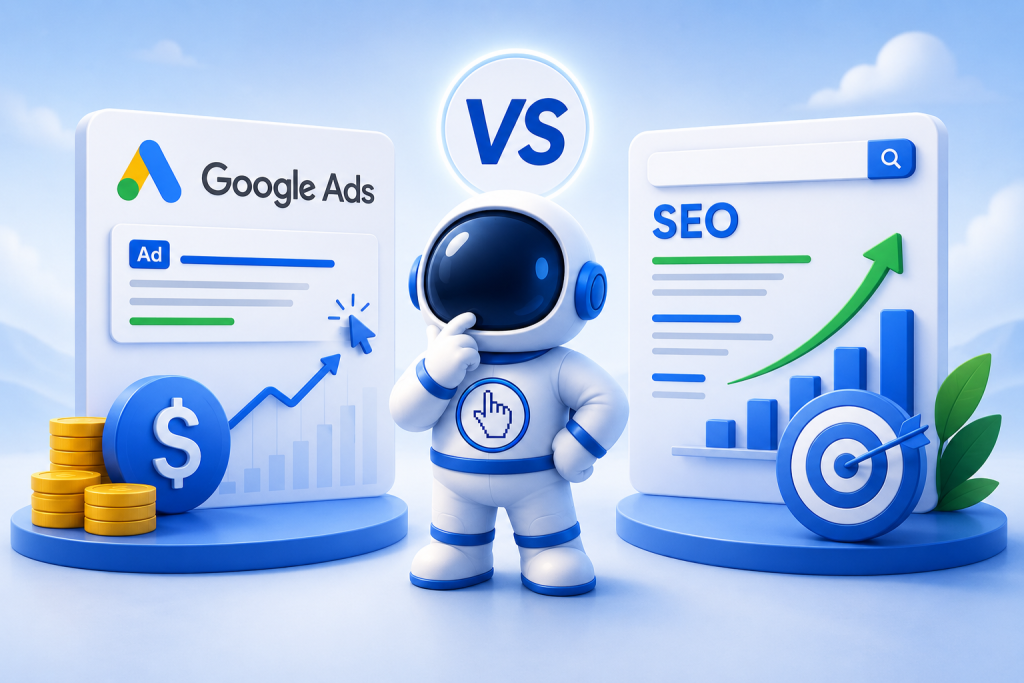
Google Ads and SEO both help businesses appear in search results, but they achieve visibility differently. Google Ads uses paid placements that appear almost immediately, while SEO focuses on earning organic rankings through content, technical optimization, and authority building. Google Ads delivers quick visibility, while SEO builds momentum over time. Understanding this difference is important because ROI expectations should match how each strategy works.
What Google Ads Does
Google Ads operates on a pay-per-click model where businesses bid on keywords to appear in sponsored search results. This allows companies to attract targeted traffic quickly, even in competitive industries.
For example, a local roofing company can target searches like “roof repair near me” and begin generating leads within days. The tradeoff is that visibility disappears when ad spending stops.
What SEO Does
SEO focuses on improving organic visibility through optimized content, technical improvements, backlinks, and user experience. Instead of paying for each click, businesses invest in building authority that can generate recurring traffic over time.
An accounting firm, for example, may publish articles targeting “small business tax tips” or “how to reduce quarterly taxes.” Once rankings improve, those pages can continue attracting leads for months or years.
How ROI Is Measured in Digital Marketing
ROI is not only about traffic volume. Businesses should also evaluate lead quality, customer acquisition cost, conversion rates, and customer lifetime value. A campaign generating fewer but higher-quality leads may produce better returns than one driving large amounts of low-converting traffic. Because Google Ads and SEO work differently, businesses should measure them using different timelines and expectations.
Important Metrics to Track
When comparing Google Ads and SEO, focus on:
- Cost per lead
- Customer acquisition cost
- Conversion rate
- Return on ad spend
- Organic traffic growth
- Lead quality
- Customer lifetime value
Why Short-Term ROI Can Be Misleading
Google Ads often produces faster measurable results because campaigns can begin generating leads almost immediately. SEO usually takes several months before rankings and traffic improve significantly.
This leads many businesses to underestimate SEO. While slower initially, SEO often becomes more cost-effective over time because businesses are no longer paying for every click.
Google Ads vs SEO Advantages in 2026

Both Google Ads and SEO remain powerful digital marketing strategies in 2026, but they deliver results in different ways. Google Ads helps businesses generate immediate visibility, targeted traffic, and faster lead generation through paid placements, while SEO focuses on building long-term authority, sustainable organic traffic, and lower acquisition costs over time. Understanding the strengths of each strategy helps businesses choose the right approach based on their goals, timeline, and budget.
Why Google Ads Remains Powerful
Google Ads continues to be one of the fastest ways to attract targeted traffic and generate leads. AI-driven bidding, automation, and advanced audience targeting have improved campaign efficiency, making it easier for businesses to scale successful campaigns quickly.
Key Advantages of Google Ads
- Immediate visibility on Google search results
- Faster lead generation and campaign testing
- Strong targeting for high-intent keywords
- Detailed performance tracking and conversion data
- Flexible scaling for promotions and new market expansion
Businesses often use Google Ads for:
- Seasonal promotions
- Product launches
- Emergency services
- Time-sensitive campaigns
- Competitive search markets
Google Ads also provides detailed metrics such as clicks, conversions, call tracking, and return on ad spend, allowing businesses to optimize campaigns quickly and improve profitability.
Why SEO Continues to Deliver Long-Term Value
SEO remains one of the most sustainable digital marketing investments available. Although it takes longer to produce results, strong organic rankings can generate ongoing traffic and leads without paying for every visitor.
Key Advantages of SEO
- Lower long-term customer acquisition costs
- Higher trust and credibility in search results
- Compounding traffic growth over time
- Stronger long-term brand authority
- Sustainable lead generation without ongoing ad spend
SEO works especially well for businesses that regularly publish useful content and want to build authority in their industry. As websites gain backlinks, publish optimized content, and improve technical performance, rankings often improve across multiple keywords and pages.
Many users also trust organic search results more than paid advertisements, making SEO particularly valuable for industries such as healthcare, finance, legal services, consulting, and B2B marketing.
When Google Ads Delivers Better ROI
Google Ads often produces stronger ROI for businesses that need immediate lead generation or operate in highly transactional markets. Campaigns can launch quickly, test messaging in real time, and scale efficiently when performance improves. This level of control makes paid advertising valuable for businesses focused on fast growth.
Businesses That Need Fast Results
Google Ads works well for:
- Home service companies
- Emergency repair businesses
- Ecommerce launches
- Event promotions
- Businesses with aggressive growth goals
In these situations, waiting months for SEO results may not be practical.
Competitive Search Markets
Some industries are extremely competitive in organic search. Smaller businesses may struggle to rank against large established brands. Google Ads allows them to compete for visibility immediately.
Testing Demand Before Investing in SEO
Paid advertising helps businesses test keywords, offers, and landing pages before investing heavily in long-term SEO campaigns. This data can later guide content strategy and keyword targeting.
When SEO Delivers Better ROI
SEO often produces stronger ROI for businesses focused on long-term authority, sustainable lead generation, and lower acquisition costs. Although it requires patience, strong organic visibility can continue generating value long after content is published.
Businesses With Longer Sales Cycles
Industries like B2B services, consulting, healthcare, and education often benefit from SEO because customers spend more time researching before making decisions. Educational content helps build trust throughout that process.
Content-Driven Industries
Businesses that can regularly publish useful content often perform well with SEO, including:
- Marketing agencies
- Financial advisors
- Law firms
- SaaS companies
- Healthcare providers
Companies Seeking Long-Term Stability
SEO creates a more stable traffic source compared to paid advertising. While ad costs can increase over time, strong organic rankings may continue generating traffic without rising acquisition costs.
Why Combining Both Often Creates the Best ROI
Many businesses treat Google Ads and SEO as competing strategies, but they often work best together. Paid ads can generate immediate traffic while SEO builds long-term authority and visibility. Combining both strategies creates a more balanced and resilient marketing approach.
Using Google Ads Data to Improve SEO
Google Ads provides valuable keyword and conversion data that businesses can use to guide SEO strategy. Companies can identify which searches produce the highest-quality leads before creating long-form content around those topics.
Using SEO to Reduce Ad Dependence
As organic rankings improve, businesses may reduce spending on certain paid keywords. This lowers acquisition costs while maintaining visibility.
Building a Full-Funnel Strategy
SEO often works best for educational and research-focused searches, while Google Ads performs better for transactional searches. Together, they support different stages of the customer journey and improve overall marketing performance.
How AI Is Changing SEO and Google Ads in 2026
Artificial intelligence is reshaping digital marketing rapidly. Both SEO and Google Ads are becoming more automated, data-driven, and personalized. Businesses that adapt to these changes are more likely to maintain strong ROI and competitive visibility.
AI-Powered Search Is Changing SEO
Google continues integrating AI-generated summaries and enhanced search experiences into results pages. This makes high-quality, expert-driven content more important than ever. Thin content written only for keywords is becoming less effective.
AI Automation in Google Ads
Google Ads now relies heavily on AI for bidding, targeting, and campaign optimization. While automation can improve efficiency, businesses still need strong messaging, quality landing pages, and clear conversion goals to achieve good results.
Which Strategy Should Small Businesses Prioritize?
The right strategy depends on business goals, budget, timeline, and competition. Businesses that need fast lead generation may benefit more from Google Ads, while companies focused on long-term authority and sustainable growth may prioritize SEO. In many cases, the strongest approach is phased investment, using ads for immediate visibility while building SEO over time.
Start With Your Goals
If the priority is immediate lead generation, Google Ads may produce faster returns. If the focus is long-term growth and reducing acquisition costs, SEO is often the better investment.
Consider Budget and Timeline
SEO requires patience and consistent effort before delivering strong results. Businesses with limited cash flow may prefer the faster returns of paid advertising, even though costs can increase over time.
Evaluate Competition
Before choosing a strategy, businesses should evaluate:
- Keyword competition
- Cost per click
- Existing domain authority
- Content opportunities
- Local search demand
This helps identify where marketing investment is most likely to generate profitable growth.
Final Thoughts
There is no universal winner in the Google Ads versus SEO debate. The right strategy depends on how quickly a business needs results, how competitive the market is, and whether the focus is short-term lead generation or long-term authority.
Google Ads can deliver fast visibility and measurable results, while SEO creates sustainable growth and lower long-term acquisition costs. Businesses that combine both strategically often create the strongest and most stable ROI over time.
If your business is trying to decide where to invest marketing budget in 2026, Click Catalyst can help you build a strategy that balances immediate performance with long-term growth.
Key Takeaways
- Google Ads delivers immediate visibility and faster lead generation
- SEO builds long-term authority and sustainable organic traffic
- ROI should be measured differently for paid and organic channels
- Google Ads works well for short-term campaigns and competitive markets
- SEO often becomes more cost-effective over time
- Combining SEO and Google Ads frequently produces the strongest results
- AI is changing how both SEO and paid advertising perform in 2026