

Many small businesses are active on social media but struggle to connect that effort to real revenue. Posting regularly, chasing trends, and growing followers often feels productive, yet sales do not always follow. This gap between activity and results is one of the biggest frustrations in modern marketing.
The challenge matters because time and budget are limited. If social media is not contributing to sales, it becomes a cost rather than an asset. Business owners need clarity on what actually works, not just what is popular.
This article breaks down the key social media strategies in 2026 that are proven to drive sales. You will learn what has changed, why it matters, and how to apply these insights in a practical way.
Social media is no longer about reach, it is about relevance
Social platforms have evolved beyond simple broadcasting channels. Algorithms now prioritize content that creates meaningful interactions rather than content that reaches the most people. This means businesses must focus on relevance to a specific audience instead of trying to appeal to everyone. When your content aligns closely with your audience’s needs, it naturally performs better and leads to stronger engagement. This shift is supported by insights from platforms like Hootsuite and Sprout Social, which emphasize quality interactions over vanity metrics.
What relevance looks like in practice
Relevance means understanding your audience’s problems, interests, and intent. A local service business, for example, will benefit more from answering common customer questions than from posting generic inspirational quotes.
It also means tailoring content to each platform. What works on LinkedIn may not resonate on Instagram or TikTok. Matching your message to the platform context increases the chances of meaningful engagement.
Short-form video continues to dominate attention
Short-form video remains one of the most effective formats for capturing attention and driving action. Platforms like TikTok, Instagram Reels, and YouTube Shorts have trained users to consume quick, engaging content. These formats are not just about entertainment, they are increasingly used for product discovery and decision-making. Businesses that adapt to this format can build awareness and move potential customers closer to a purchase.
Why short-form video works
Short videos reduce friction. They are easy to consume and often feel more authentic than polished ads. This makes them ideal for building trust quickly.
They also allow businesses to demonstrate value in seconds. A quick product demo or before-and-after example can be more persuasive than a long description.
How to use it effectively
Focus on clarity over creativity. Your message should be easy to understand within the first few seconds. Start with a strong hook that addresses a problem or curiosity.
Consistency matters more than perfection. Posting regularly helps you learn what resonates and improves performance over time.
Social commerce is becoming the default buying experience
Social media platforms are increasingly integrating shopping features directly into the user experience. Customers can now discover, evaluate, and purchase products without leaving the app. This shift shortens the buyer journey and removes friction from the decision-making process. As a result, businesses that embrace social commerce can capture demand more efficiently.
Key features driving social commerce
In-app checkout, product tagging, and live shopping events are becoming standard. These features make it easier for users to move from interest to purchase in a few clicks.
User-generated content also plays a major role. Reviews, testimonials, and customer photos build trust and influence buying decisions.
Authenticity is outperforming polished branding
Highly polished content is no longer the most effective way to connect with audiences. Users are increasingly drawn to content that feels real, relatable, and human. This trend reflects a broader shift in consumer behavior toward transparency and trust. Businesses that embrace authenticity can build stronger relationships with their audience.
What authentic content looks like
Behind-the-scenes videos, honest product reviews, and real customer stories are powerful formats. These types of content help humanize your brand and make it more approachable.
Mistakes and imperfections are not always negative. In many cases, they make your content feel more genuine and trustworthy.
Engagement is a sales signal, not just a metric
Likes, comments, and shares are often seen as vanity metrics, but they play a deeper role in the sales process. Engagement signals interest and intent, which can influence both algorithms and customer perception. High engagement increases visibility and builds social proof, both of which contribute to sales.
Turning engagement into revenue
Responding to comments and messages quickly can move potential customers closer to a purchase. Conversations create opportunities to answer questions and address objections.
Call-to-action strategies are also important. Encouraging users to take the next step, such as visiting your website or sending a message, helps convert engagement into measurable results.
Data-driven decisions are replacing guesswork
Successful social media marketing in 2026 relies on data rather than assumptions. Platforms provide detailed analytics that can guide content strategy and improve performance. Businesses that use this data effectively can identify what works and scale it.
Metrics that actually matter
Focus on metrics tied to business outcomes. These include click-through rates, conversions, and customer acquisition cost.
Engagement metrics are still useful, but they should be viewed in context. High engagement without conversions may indicate a mismatch between content and offer.
Paid social is more precise and more necessary
Organic reach alone is often not enough to achieve consistent results. Paid social advertising allows businesses to target specific audiences and scale successful campaigns. With improved targeting capabilities, ads can reach users who are more likely to convert.
How to approach paid social
Start with small budgets and test different creatives and audiences. Identify what performs best before increasing spend.
Retargeting is especially effective. Showing ads to users who have already interacted with your brand increases the likelihood of conversion.
Building a simple, effective social media strategy
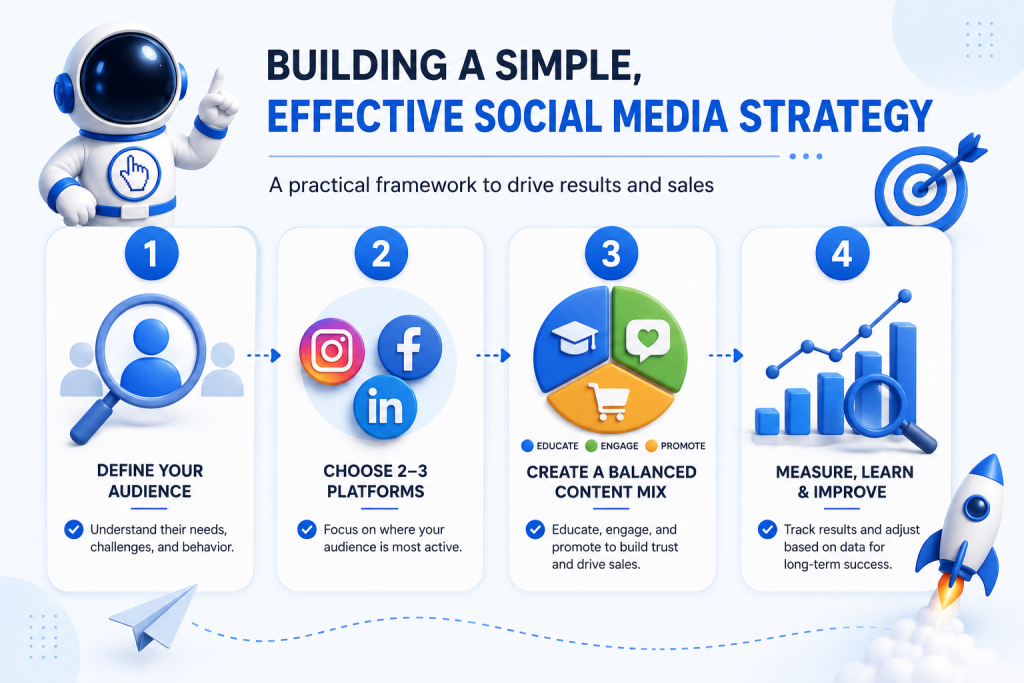
A successful strategy does not need to be complex. In fact, simplicity often leads to better execution and consistency. The key is to focus on a few high-impact actions rather than trying to do everything at once.
A practical framework
Define your audience clearly. Understand their needs, challenges, and behavior on social media.
Choose two to three platforms where your audience is most active. Focus your efforts there instead of spreading yourself too thin.
Create a content mix that includes education, engagement, and promotion. This balance helps build trust while driving sales.
Measure results regularly and adjust your approach based on data. Continuous improvement is essential for long-term success.
Turning strategy into results
Understanding trends is important, but execution is what drives results. Businesses that apply these strategies consistently are more likely to see a measurable impact on sales. The goal is not to follow every trend, but to focus on what aligns with your audience and business objectives.
Where to go from here
Start by evaluating your current social media efforts. Identify what is working and what is not. Then, apply one or two of the strategies discussed in this article and measure the results.
If you need guidance building a strategy that aligns with your business goals, Click Catalyst can help you create a focused, data-driven approach that turns social media into a reliable sales channel.
Key Takeaways
- Social media success in 2026 depends on relevance, not reach
- Short-form video is a primary driver of engagement and discovery
- Social commerce reduces friction and speeds up the buying process
- Authentic content builds trust and outperforms polished branding
- Engagement signals can directly influence sales outcomes
- Data-driven strategies lead to more consistent results
- Micro-influencers often deliver higher ROI than large influencers
- Paid social is essential for scaling and targeting effectively