

Many small business owners feel like marketing is a guessing game. One month they try posting more on social media. The next month they boost a few ads, rewrite a website page, or send an email campaign, hoping something finally works.
The problem is not always effort. In many cases, the problem is that the marketing activity is not connected to a clear strategy, measurable goals, or a real understanding of the customer journey.
A strong marketing strategy helps you make better decisions before spending time or money. It gives every campaign a purpose, every channel a role, and every result a lesson you can use to improve.
Why Guesswork Happens in Small Business Marketing
Guesswork usually happens when a business jumps straight into marketing tactics without defining the bigger picture first. For example, a business might run Facebook ads before knowing who the ideal customer is, what problem they care about most, or what action the ad should lead to. This creates scattered activity, where each marketing task feels separate from the others.
A clear marketing strategy connects your audience, message, channels, budget, and tracking into one practical plan. Many businesses fall into the same avoidable habits before they ever create a strategy. Understanding these common mistakes can make it much easier to build a marketing plan that produces consistent results.
You Focus on Activity Instead of Outcomes
It is easy to mistake being busy for making progress. Posting daily, running ads, sending emails, and updating your website can all feel productive, but they only matter if they support a specific goal.
Instead of asking, “What should we post this week?” start with, “What business result are we trying to create?” That result might be more quote requests, booked calls, store visits, repeat purchases, or newsletter signups.
You Copy What Other Businesses Are Doing
Many small businesses copy competitors because it feels safer than starting from scratch. But your competitors may have a different budget, audience, offer, or sales process.
A strategy based on imitation can lead you away from what your customers actually need. It is better to study competitors for context, then build your own plan around your strengths and your customers’ real behavior.
Start With a Clear Business Goal
Your marketing strategy should start with a clear business goal, not a marketing platform. Goals like “get more visibility” are too vague. Instead, define a specific objective, such as increasing website inquiries or generating more qualified leads. Clear goals make it easier to choose the right channels, content, budget, and metrics.
Make the Goal Specific
A vague goal leads to vague marketing. “Grow the business” sounds good, but it does not help you decide whether to invest in SEO, Google Ads, social media, or email marketing.
A specific goal gives your strategy direction. For example, a local electrician may want more emergency callouts, while a boutique may want more repeat purchases from existing customers.
Connect the Goal to Revenue
Not every marketing metric is equally useful. Likes, impressions, and clicks can help you understand reach, but they do not always show whether marketing is creating revenue.
Better goals are tied to actions that move someone closer to becoming a customer. These could include phone calls, contact form submissions, booked consultations, product sales, or return visits.
Understand Who You Are Trying to Reach
A strong marketing strategy starts with understanding your audience. Focus on your customers’ problems, motivations, concerns, and how they make decisions. The better you understand them, the more relevant and effective your marketing will be.
Identify the Customer’s Main Problem
Most customers are not looking for a business because they enjoy researching options. They are trying to solve a problem, avoid a risk, save time, reduce stress, or achieve a better result.
For example, a homeowner searching for a plumber may not care about technical plumbing terms. They want someone reliable who can fix the issue quickly and explain the cost clearly.
Learn What Holds Them Back
Customers often hesitate before buying. They may worry about price, trust, timing, quality, or whether your solution is right for them.
Good marketing addresses these concerns before they become objections. This could mean adding testimonials, explaining your process, showing before-and-after examples, or making your pricing easier to understand.
Build Your Message Before Choosing Your Channels
Many businesses choose marketing channels before defining their message. Start by clearly explaining who you help, the problem you solve, and why your solution matters. Once your message is clear, you can adapt it across your website, SEO, PPC, social media, and email marketing.
Clarify Your Value Proposition
Your value proposition is the simple reason someone should choose your business over another option. It should be clear, specific, and focused on the customer’s outcome.
For example, “We offer accounting services” is basic. “We help small business owners stay tax-ready without the last-minute stress” is more useful because it speaks to a real pain point.
Keep Your Message Consistent
Consistency builds trust. If your website says one thing, your ads say another, and your social media posts feel unrelated, customers may not understand what your business is really about.
A consistent message helps people remember you. It also makes your marketing easier to manage because every campaign is built from the same foundation.
Choose Marketing Channels Based on Customer Behavior
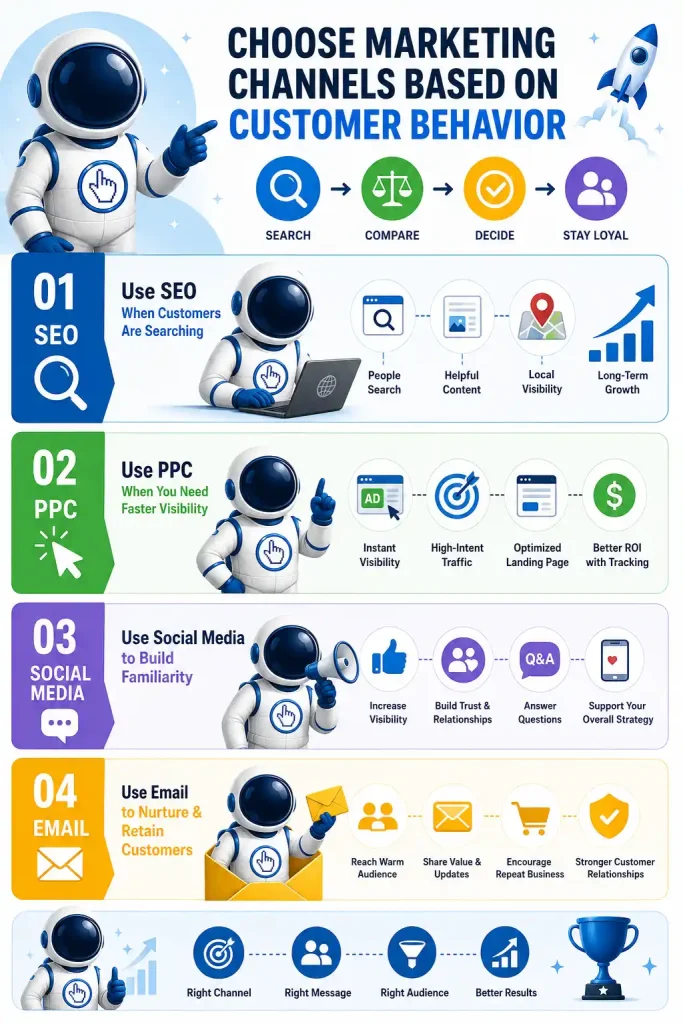
The best marketing channel is not always the newest or most popular one. The best channel is the one that matches how your customers search, compare, and decide. SEO can work well when people actively search for your services, while PPC can help you appear quickly for high-intent keywords. Social media and email can support trust, education, reminders, and repeat business.
Use SEO When Customers Are Searching
Search engine optimization is useful when your customers already know they have a problem and are looking for answers. Blog posts, service pages, and local SEO content can help your business appear when people search for solutions.
For example, a small law firm might create content around common legal questions. A home service business might focus on local service pages and helpful maintenance guides.
Use PPC When You Need Faster Visibility
Pay-per-click advertising can help your business get in front of potential customers faster than organic SEO. This is especially useful for competitive services, seasonal offers, or campaigns with a clear conversion goal.
However, PPC works best when your landing page, offer, and tracking are ready. Sending paid traffic to a confusing page can waste budget quickly.
Use Social Media to Build Familiarity
Social media marketing is often best for staying visible, building trust, and showing the human side of your business. It can also help answer common questions and show proof of your work.
For many small businesses, social media should support the bigger strategy rather than carry the entire marketing plan alone. It works better when connected to your website, email list, and sales process.
Use Email to Nurture and Retain Customers
Email marketing is valuable because it lets you speak to people who have already shown interest in your business. This could include past customers, leads, subscribers, or people who downloaded a guide.
Simple emails can remind customers about services, share helpful tips, promote seasonal offers, or encourage repeat purchases. Unlike social media, email gives you more control over your audience relationship.
Track the Metrics That Actually Matter
A marketing strategy without tracking quickly becomes guesswork. Use tools like Google Analytics to understand how people find and use your website, then use those insights to improve your marketing. Focus on the metrics that show whether your efforts are driving real business results.
Focus on Conversion Metrics
Conversions are the actions that matter most to your business. These may include calls, form submissions, purchases, bookings, email signups, or quote requests.
Traffic matters, but conversion tells you whether that traffic is useful. A website with fewer visitors but more qualified leads may be performing better than a site with lots of visitors who never take action.
Watch Channel Performance
Different channels often play different roles. SEO may bring long-term traffic, PPC may generate immediate leads, social media may build familiarity, and email may bring people back.
Tracking channel performance helps you avoid cutting a channel too early or overinvesting in one that looks busy but does not create results. It also helps you understand where customers first discover you and where they finally convert.
Review Quality, Not Just Quantity
More leads are not always better if they are poor quality. A strategy should consider whether your marketing is attracting the right people, not just more people.
For example, if your ads generate many inquiries but few serious buyers, your keywords, targeting, offer, or landing page may need adjustment. Quality matters because it affects your time, sales process, and profit.
Turn Data Into Better Decisions
Data is only valuable if you use it to improve your marketing. Regularly review your results to identify what is working, what is not, and what should be adjusted or tested next. Small, informed changes can lead to better long-term performance.
Look for Patterns
One result does not always tell the full story. Look for patterns across several weeks or months before making major decisions.
For example, if several blog posts about one topic bring in strong traffic and leads, that may be a sign to create more content around that customer need. If one ad campaign spends heavily but rarely converts, it may need a stronger offer or a better landing page.
Test One Change at a Time
Testing helps you improve without guessing. But if you change too many things at once, you will not know which change made the difference.
You might test a headline, call to action, landing page layout, email subject line, or ad audience. Small, controlled tests can lead to steady improvement over time.
Create a Simple Marketing Plan You Can Actually Follow
A useful marketing plan does not need to be complicated. In fact, the best plan for a small business is often simple enough to review every month. It should include your goal, target audience, core message, chosen channels, content plan, budget, tracking method, and review schedule. When the plan is practical, your team is more likely to follow it consistently.
Set Monthly Priorities
Trying to improve everything at once can lead to frustration. Choose a few priorities each month based on your main goal.
For example, one month might focus on improving website conversion. Another month might focus on publishing SEO content, testing Google Ads, or building an email follow-up sequence.
Assign Clear Responsibilities
Even a simple strategy can fail if no one owns the work. Decide who is responsible for creating content, reviewing analytics, managing ads, updating the website, and following up with leads.
This is especially important for small teams where people already wear many hats. Clear ownership prevents important tasks from being forgotten.
Review and Adjust Regularly
A marketing strategy should not be created once and ignored. Customer behavior, competition, budgets, and business goals can change.
A monthly review helps you stay focused and flexible. It gives you a chance to learn from real results instead of relying on assumptions.
A Practical Example of Strategy Without Guesswork
Imagine a local cleaning company wants more recurring clients. Instead of relying on random marketing, it sets a clear goal, targets busy homeowners, creates local SEO content, runs Google Ads, and follows up with past customers by email. Each month, it reviews key metrics like inquiries, bookings, and cost per lead to measure success.
What Makes This Strategy Strong
The company is not relying on one random tactic. Each channel has a role in the customer journey.
SEO captures people searching for cleaning services. PPC creates faster visibility, email brings back warm contacts, and the website turns interest into inquiries.
How the Business Learns Over Time
After a few months, the company may discover that certain locations convert better than others. It may also learn that “recurring house cleaning” leads are more profitable than one-time deep cleaning leads.
Those insights can guide future decisions. The business can adjust its budget, content, and offers based on evidence instead of guesswork.
Ready to Make Your Marketing More Strategic?
If your marketing feels scattered, Click Catalyst can help you turn disconnected tactics into a clearer digital marketing strategy. From SEO and PPC to content, tracking, and campaign planning, the goal is to help your business understand what is working and what needs to improve. A stronger strategy does not remove every challenge, but it gives you a better way to make decisions. When your marketing is guided by data and purpose, every step becomes easier to measure and refine.
Key Takeaways
- Start with a specific business goal, not a marketing tactic.
- Understand your customer’s problem, hesitation, and decision process.
- Build a clear message before choosing channels.
- Choose SEO, PPC, social media, and email based on customer behavior.
- Track conversions, lead quality, and channel performance.
- Review results regularly and make small improvements over time.
- Avoid judging success by visibility alone.
- Use data to guide decisions, not overwhelm your team.