

Getting people to visit your website is only half the battle. Many small business owners invest time and money into SEO, Google Ads, or social media marketing, only to discover that while traffic is increasing, inquiries and sales remain disappointingly low. This can be frustrating, especially when your analytics suggest everything is moving in the right direction.
The truth is that website traffic alone does not generate revenue. What matters is whether your visitors are taking meaningful actions, such as requesting a quote, booking a consultation, or making a purchase. If they are leaving without engaging, your website is likely suffering from conversion issues rather than traffic problems.
In this article, you’ll learn why websites often fail to turn visitors into customers, the most common causes behind poor conversion rates, and practical ways to improve your website so it becomes a reliable source of leads.
Understanding the Difference Between Traffic and Conversions
Many business owners celebrate growing website traffic because it feels like progress. While attracting visitors is important, it only represents the top of the marketing funnel. A successful website should guide visitors toward taking a desired action, whether that is filling out a contact form, downloading a resource, or scheduling a consultation. Without conversions, even thousands of monthly visitors may contribute little to your business growth.
What is Website Traffic?
Website traffic refers to the number of people who visit your website. These visitors may come from various sources, including:
- Google Search
- Google Ads
- Social media platforms
- Email marketing campaigns
- Referral websites
- Direct visits
Traffic tells you how many people arrive at your site, but it does not reveal whether they found what they needed or took action.
What is a Conversion?
A conversion occurs when a visitor completes an action that supports your business goals. Examples include:
- Filling out a contact form
- Calling your business
- Booking an appointment
- Requesting a proposal
- Downloading a guide
- Making a purchase
- Subscribing to your newsletter
Your website’s primary purpose should be converting visitors into potential customers, not simply attracting clicks.
Common Reasons Your Website Gets Traffic but No Leads
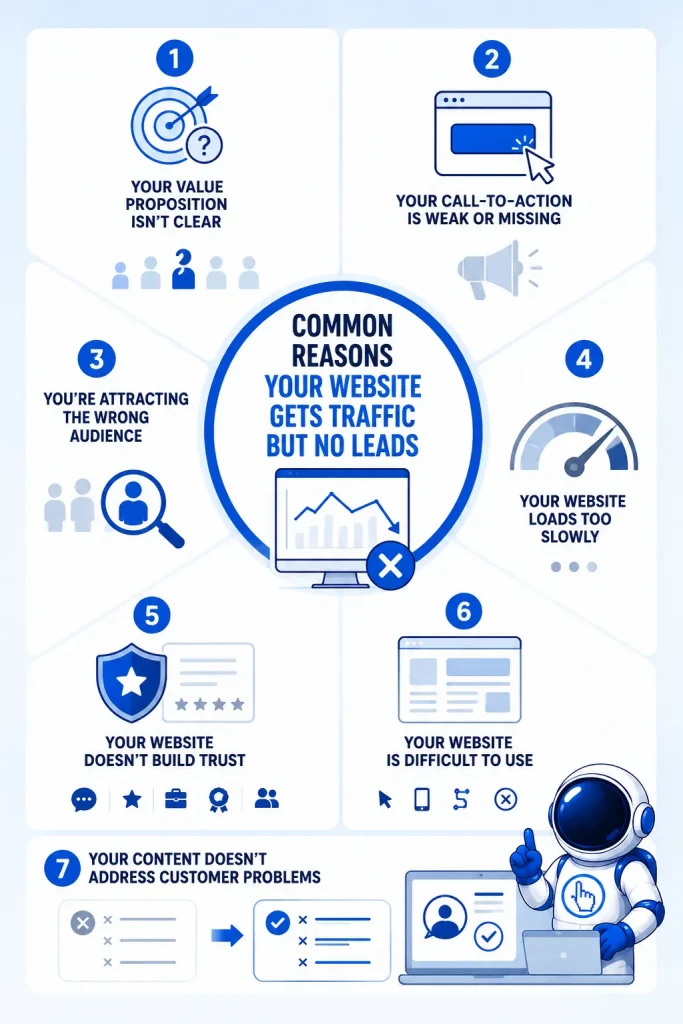
There are several reasons why visitors may leave without contacting your business. Identifying these issues is the first step toward improving your conversion rate. Often, the problem is not your marketing campaign but the experience visitors have after they arrive on your website.
Your Value Proposition Isn’t Clear
Visitors decide within seconds whether your website is relevant to their needs. If your homepage doesn’t quickly explain who you help, what you offer, and why someone should choose your business, visitors are likely to leave.
A clear headline should immediately answer questions such as:
- What does your business do?
- Who is it for?
- What problem do you solve?
- Why should someone trust you?
Avoid generic phrases like “Quality Service Since 2010.” Instead, focus on the specific benefit you provide.
Your Call-to-Action Is Weak or Missing
Many websites assume visitors know what to do next. In reality, people need guidance.
Strong calls-to-action include:
- Book a Free Consultation
- Get a Free Quote
- Schedule a Demo
- Download Our Guide
- Contact Our Team Today
Your CTA should be visible, easy to understand, and repeated naturally throughout the page.
You’re Attracting the Wrong Audience
More traffic does not always mean better traffic. If your SEO strategy targets broad or unrelated keywords, visitors may have no intention of becoming customers.
For example, someone searching “What is digital marketing?” is likely looking for educational information, while someone searching “Digital marketing agency for small business” is much closer to making a purchasing decision.
Focusing on search intent helps attract visitors who are more likely to convert.
Your Website Loads Too Slowly
Website speed has a direct impact on user experience. Even a few extra seconds of loading time can cause visitors to leave before seeing your content.
Slow websites often result from:
- Large image files
- Poor hosting
- Too many plugins
- Unoptimized code
Improving page speed benefits both user experience and search engine rankings.
Your Website Doesn’t Build Trust
Before contacting your business, visitors want reassurance that you’re credible.
Trust-building elements include:
- Customer testimonials
- Reviews
- Case studies
- Certifications
- Client logos
- Team information
- Clear contact details
Without these signals, visitors may hesitate to reach out, even if they like your services.
Your Website Is Difficult to Use
Confusing navigation or cluttered layouts create unnecessary friction.
Ask yourself:
- Can visitors find important information quickly?
- Is your navigation simple?
- Are forms easy to complete?
- Does your website work well on mobile devices?
The easier your website is to use, the more likely visitors are to convert.
Your Content Doesn’t Address Customer Problems
Many websites focus on the business rather than the customer.
Instead of listing features, explain how your services solve real problems.
For example:
Instead of:
We provide professional SEO services.
Try:
We help small businesses increase qualified website traffic and generate more leads through SEO strategies designed for long-term growth.
This shifts the focus from what you do to how you help.
Why Conversion Rate Optimization Matters
Driving more traffic to a poorly converting website is like pouring more water into a leaking bucket. If visitors continue leaving without taking action, increasing your advertising budget will only amplify the problem.
Conversion Rate Optimization (CRO) focuses on improving the percentage of visitors who become leads or customers. Small improvements to headlines, calls-to-action, page layouts, and forms can significantly increase the value of your existing traffic. Rather than constantly chasing more visitors, businesses often achieve better results by optimizing the experience for the people already arriving on their website.
Simple CRO Improvements
Some of the most effective improvements include:
- Simplify your navigation
- Improve page loading speed
- Write benefit-focused headlines
- Place clear CTAs above the fold
- Reduce the number of form fields
- Add testimonials and reviews
- Use high-quality images
- Optimize for mobile users
Even small changes can lead to measurable improvements in lead generation.
How to Measure Whether Your Website Is Converting
Many businesses only monitor traffic numbers. However, traffic alone doesn’t reveal whether your marketing is effective.
Track metrics such as:
- Conversion rate
- Contact form submissions
- Phone calls
- Quote requests
- Bounce rate
- Average engagement time
- Pages per session
Tools like Google Analytics 4 and Google Search Console provide valuable insights into visitor behavior and can help identify where users drop off before converting.
A Successful Website Is More Than Just Traffic
A high-performing website doesn’t simply attract visitors. It encourages them to take action by providing clear messaging, a strong user experience, and compelling reasons to trust your business. Every page should guide users toward the next step in their buying journey.
Businesses that consistently generate leads understand that traffic is only one part of the equation. By focusing on conversion optimization, user experience, and customer intent, they maximize the return on every marketing dollar they spend.
Ready to Turn More Website Visitors Into Leads?
If your website is attracting traffic but not generating inquiries, the problem may not be your marketing campaigns. Often, small improvements to your messaging, design, user experience, and conversion strategy can make a significant difference.
At Click Catalyst, we help businesses identify why visitors aren’t converting and develop data-driven strategies that transform websites into effective lead generation tools. Whether you need a website audit, conversion optimization, SEO, or digital marketing support, our team can help you turn more of your existing traffic into real business opportunities.
Key Takeaways
- Website traffic alone does not generate leads or sales.
- Clear messaging helps visitors quickly understand your value.
- Strong calls-to-action encourage users to take the next step.
- Attracting the right audience is more important than attracting more visitors.
- Fast-loading, user-friendly websites improve conversion rates.
- Trust signals such as testimonials and case studies increase credibility.
- Conversion Rate Optimization helps maximize the value of existing traffic.
- Measuring conversions is more valuable than simply tracking visitor numbers.